
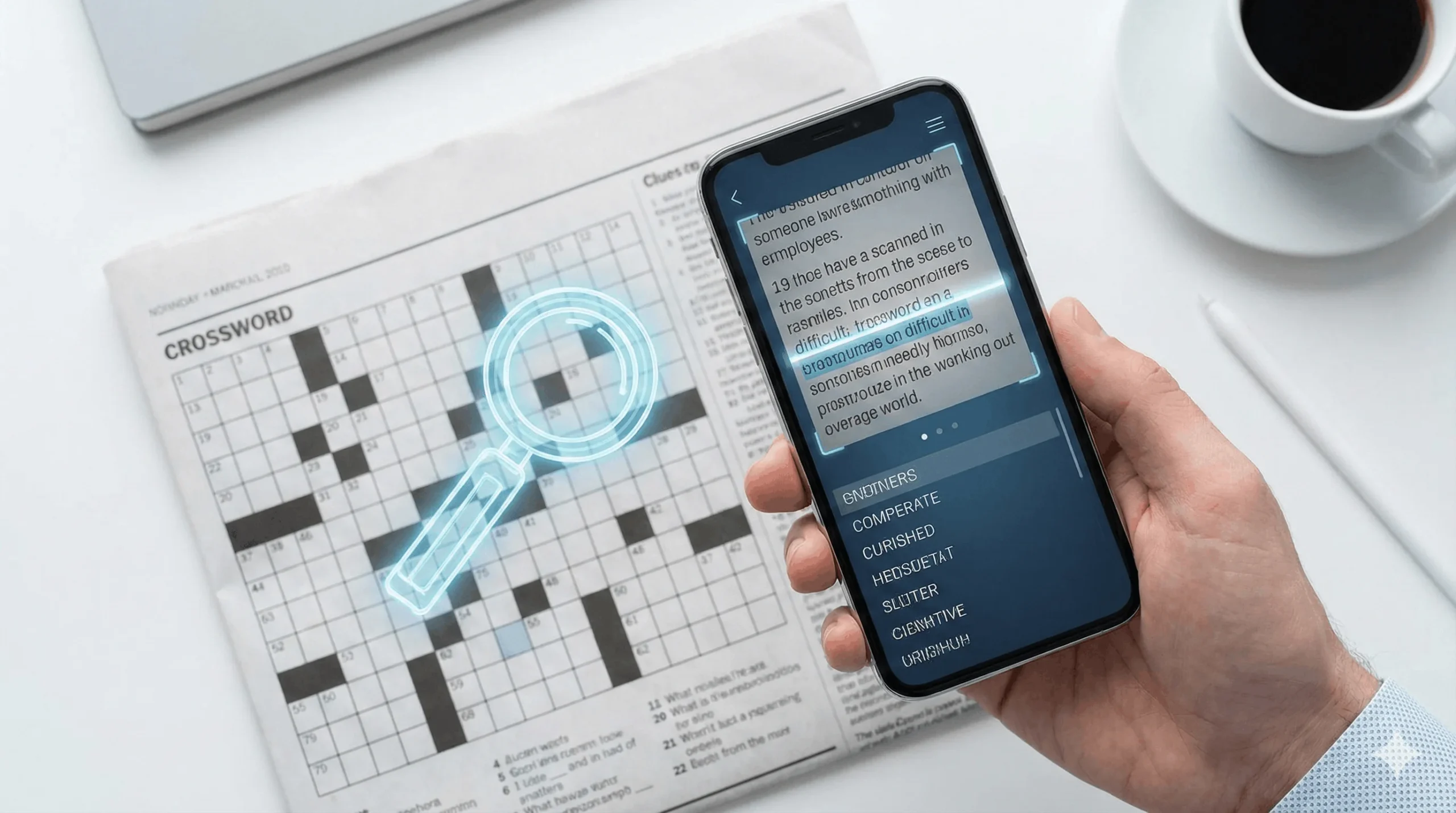

Have you ever been stumped by a crossword puzzle, desperately seeking a solution to a tricky clue? Or have you encountered a short puzzle where the answer seems just out of reach? Text-scanning technology can be surprisingly relevant in these situations, offering a digital helping hand. This article explores the fascinating connection between text-scanning technology and the world of crossword puzzles, short answers, and other word-based games. We’ll delve into how this technology works, its various applications, and how it can assist you in finding those elusive answers. Prepare to uncover the potential of text-scanning technology and how it cleverly intertwines with the challenges of crosswords and similar puzzles.
What is Text-Scanning Technology?
Text-scanning technology is a process that converts images of text, whether printed or handwritten, into machine-readable text. This technology utilizes optical character recognition (OCR) to analyze the shapes of characters within an image and translate them into digital text that a computer can understand. Think of it as a digital eye that can “read” a document and turn it into something you can edit, search, or otherwise manipulate on your computer. The applications of text-scanning technology are vast, ranging from digitizing old books to automating data entry processes. Text-scanning technology’s ability to process text quickly makes it a valuable tool for archiving documents and extracting information from various sources.
How Text-Scanning Technology Works
The transition from a physical puzzle to a digital solution involves a sophisticated three-step pipeline:
- Capture & Pre-processing: First, a camera or scanner captures a high-resolution image. The software then “cleans” the image, adjusting contrast and removing noise, to ensure the characters stand out against the background.
- Feature Extraction & Pattern Recognition: This is the “brain” of the operation. The OCR engine analyzes the shapes for specific features, like the curve of an ‘O’ or the crossbar of a ‘T.’ It compares these patterns against a massive database of fonts and handwriting styles to identify the most likely character match.
- Contextual Refinement: Modern systems don’t just read letters; they read words. Advanced algorithms use built-in dictionaries and error-correction models to resolve ambiguities. For instance, if a scan is blurry, the tech can “guess” a character based on the surrounding letters, ensuring the potential crossword answer is linguistically logical.
Key Takeaway: By breaking down visual data into recognizable geometric patterns, text-scanning technology transforms a static image into a dynamic, searchable solution.
Applications of Text-Scanning Technology
While invaluable for word games, the versatility of OCR technology spans multiple critical sectors:
- Corporate Automation: Drastically reduces manual entry by extracting data from invoices, legal contracts, and receipts with over 99% accuracy.
- Inclusive Education: Empowers students with visual impairments by converting printed textbooks into high-quality text-to-speech or Braille output.
- Heritage Preservation: Allows libraries to transform fragile, centuries-old documents into searchable digital repositories without risking further physical degradation.
- Information Management: Facilitates “instant search” within massive PDF databases, turning thousands of static pages into a fully navigable knowledge base.
Strategic Solving: The Crossword Connection
Text-scanning technology serves as a force multiplier for puzzle enthusiasts. When a clue feels impossible, digitizing it allows you to tap into global linguistic databases:
The Power of Short Answers
In crosswords, 3-letter “fillers” are often the most difficult because they rely on niche abbreviations or obscure acronyms. OCR allows you to cross-reference these fragments against comprehensive databases of common crossword grid “glue.”
Pattern-Based Discovery
Once a clue is scanned, you can use pattern-based searches to find every possible linguistic match in seconds. If you have a few letters of an answer (e.g., S_A_N), the technology helps you filter thousands of possibilities instantly.
Contextual Validation
Beyond just finding a word, technology helps you verify the definition and “thematic fit” of a solution, ensuring that your answer aligns with the puzzle creator’s logic and the intersecting words in the grid.
The AI Revolution in Linguistics
The future of scanning technology lies in Neural OCR. Unlike traditional systems that look for static shapes, AI-driven models understand semantic context, which is a game-changer for puzzle solvers.
- Cryptic Deciphering: Future tools won’t just read the words; they will interpret the puns and “misdirections” inherent in cryptic crossword clues.
- Handwriting Adaptation: Machine learning helps technology “learn” your specific handwriting style over time, making it easier to scan your own filled-out grids.
- Generative Solving: We are moving toward a reality where AI doesn’t just solve puzzles, it collaborates with the user, offering hints or teaching underlying wordplay patterns to help you become a better solver.
Using Technology to Solve Crossword Puzzles
Text-Scanning Technology in Puzzle Solving
Text-scanning technology offers a modern approach to solving crossword puzzles. When faced with a particularly challenging crossword clue, you can use scanning technology to digitize the clue and quickly search for potential answers online. This approach is especially useful when dealing with cryptic clues or clues that rely on obscure knowledge. By inputting the clue that we have spotted into a search engine or a specialized crossword database, you can generate a list of possible answers that match the length and context of the clue. Furthermore, scanning technology facilitates the research process, allowing you to quickly access definitions, synonyms, and related clues, making it easier to find the correct answer and enjoy the puzzle-solving experience.
Optimizing Clue Searches
To optimize your clue searches using technology, it’s essential to leverage the full capabilities of text-scanning technology. Start by accurately scanning the crossword puzzle clue to ensure the digital text is error-free. Next, use advanced search operators and filters to narrow down the possible answers. For example, specify the number of letters in the answer or include any known letters within the word. Utilize specialized crossword databases and search engines designed to handle cryptic clues and brief definitions. By combining precise scanning with effective search strategies, you can significantly improve your chances of finding the correct solution and conquer even the most challenging crossword puzzles efficiently, thus increasing your chances of finding another solution.
Exploring Potential Answers
Once you have a list of potential answers generated by scanning technology, it’s time to evaluate each option critically. Consider the context of the crossword clue and how well each possible answer fits into the surrounding words in the grid. Check for any thematic connections or recurring patterns within the puzzle that might provide additional hints. Use online dictionaries and thesauruses to verify the definitions and synonyms of the potential answers. If you’re still unsure, try entering each answer into the grid to see if it creates valid words with the intersecting clues. By thoroughly exploring each potential answer and leveraging all available resources, you can confidently identify the correct solution and complete the puzzle while employing the best strategies for solutions for text-scanning technology.
The Future of Crossword Solving with Technology
Innovations in Scanning Technology
The evolution of scanning technology is continually reshaping how we approach crossword puzzles. Advanced text-scanning technology now incorporates AI-driven algorithms that can decipher even the most cryptic clues. These innovations allow for more accurate and efficient scanning of crossword clues, instantly providing a list of potential answers. Imagine a scanning tool that not only recognizes the clue but also understands the nuances of crossword terminology. Such technology can significantly reduce the time spent on research, helping enthusiasts quickly find the solution and move on to the next challenge. As these databases improve, finding the right answer becomes less about guesswork and more about leveraging cutting-edge solutions for text-scanning technology.
Challenges and Solutions in Text Recognition
Despite advancements, text-scanning technology faces challenges, especially with handwritten clues or poorly printed crossword puzzle sheets. The accuracy of text recognition can be compromised by smudged ink, unusual fonts, or varying handwriting styles. To combat these issues, developers are creating more sophisticated algorithms capable of adapting to imperfections. These algorithms use machine learning to improve recognition accuracy over time, learning from errors and becoming more adept at deciphering difficult clues. Moreover, user-friendly interfaces allow for manual corrections, ensuring that even the most challenging clues can be accurately digitized and searched, thus providing another solution.
The Impact of AI on Crossword Puzzles
Artificial intelligence is revolutionizing how we interact with crossword puzzles. AI-powered technology can not only find possible answers but also generate entire puzzles based on specific themes or difficulty levels. Imagine an AI that crafts intricate crossword puzzles tailored to your skill level, providing a unique and personalized puzzle-solving experience. Furthermore, AI algorithms can analyze vast databases of words and clues to identify obscure terms or brief definitions that might stump even the most seasoned puzzle solvers. By integrating AI into text-scanning technology, we enhance our ability to conquer crossword challenges efficiently and enjoyably, and find a new word that serves as the solution.
Summary
Text-scanning technology has moved beyond the office and into the world of leisure. By leveraging OCR and AI, puzzle enthusiasts can conquer even the most challenging grids. Whether you are looking for another solution or trying to learn the nuances of a new word, these digital tools ensure that no crossword clue remains unsolved.