

How Much Does an Ultrasound Tech Make in 2026?
Ultrasound technicians, officially called diagnostic medical sonographers, earned a median salary of $96,590 a year ($46.44/hour) as of the most recent Bureau of Labor Statistics wage data (May 2025 release, the latest figures available). Pay typically runs from about $67,820 for those newer to the field up to $129,370 or more for experienced sonographers in high-paying states and specialties.
That’s a meaningful jump from what older salary guides still circulating online report, and it reflects a field where demand, and pay, has been climbing steadily as ultrasound imaging becomes a bigger part of everyday healthcare.
Ultrasound Tech Salary at a Glance
| Metric | Figure |
|---|---|
| Median annual salary | $96,590 |
| Median hourly wage | $46.44 |
| Lowest 10% earn less than | $67,820 |
| Highest 10% earn more than | $129,370 |
| Total jobs (2025) | 92,200 |
| Projected job growth (2025–2035) | 14% (much faster than average) |
| Typical entry-level education | Associate’s degree |
Source: U.S. Bureau of Labor Statistics, Occupational Employment and Wage Statistics survey, May 2025 release.
What Does an Ultrasound Technician Do?

Diagnostic medical sonographers use high-frequency sound waves, via a handheld device called a transducer, to create real-time images of organs, tissues, blood vessels, and, in the case of pregnancy, a developing fetus. Physicians use those images to diagnose conditions ranging from gallstones to blocked arteries to early-stage tumors. It’s often the first imaging test ordered when something looks abnormal, partly because it’s noninvasive and doesn’t involve radiation.
Most sonographers work under one or more specialty areas:
- Abdominal sonography: liver, kidneys, gallbladder, pancreas, spleen
- Obstetric and gynecologic sonography: pregnancy monitoring and reproductive health
- Cardiac sonography (echocardiography): heart chambers, valves, and blood flow
- Vascular sonography: blood vessels, clots, blockages
- Breast sonography: supplementing mammograms, guiding biopsies
- Musculoskeletal sonography: muscles, tendons, ligaments, joints
- Pediatric sonography: imaging for infants and children
Sonographers who hold credentials in more than one of these areas; say, general abdominal plus vascular, are typically more competitive for higher-paying roles, since employers can schedule them across more types of exams.
Ultrasound Tech Salary by State
Location is one of the biggest swing factors in sonographer pay, driven by cost of living, local demand, and the concentration of training programs relative to open positions. Based on the latest BLS state-level wage data:
| State | Median Annual Salary |
|---|---|
| California | $128,530 |
| Hawaii | $124,430 |
| Washington | $121,340 |
| National median | $96,590 |
Higher pay in states like California doesn’t automatically mean more purchasing power once housing and taxes are factored in, a sonographer earning $90,000 in a lower-cost state can end up with a comparable or better standard of living than one earning $120,000 in a high-cost metro. Anyone weighing a relocation for pay should check local housing costs alongside the raw salary figure.
Ultrasound Tech Salary by Employer and Work Setting
Where a sonographer works matters almost as much as where they live. BLS wage data by industry shows a clear pattern:
| Work Setting | Median Annual Salary | Share of Sonographer Jobs |
|---|---|---|
| Outpatient care centers | $127,940 | 5% |
| Hospitals (state, local, private) | $97,390 | 58% |
| Offices of physicians | $95,220 | 21% |
| Medical and diagnostic laboratories | $87,580 | 11% |
Outpatient care centers pay the most on average, but hospitals employ the majority of sonographers and tend to offer more consistent scheduling, benefits, and opportunities to rotate through different specialties, a trade-off worth weighing beyond the paycheck alone.
Ultrasound Tech Salary by Experience Level
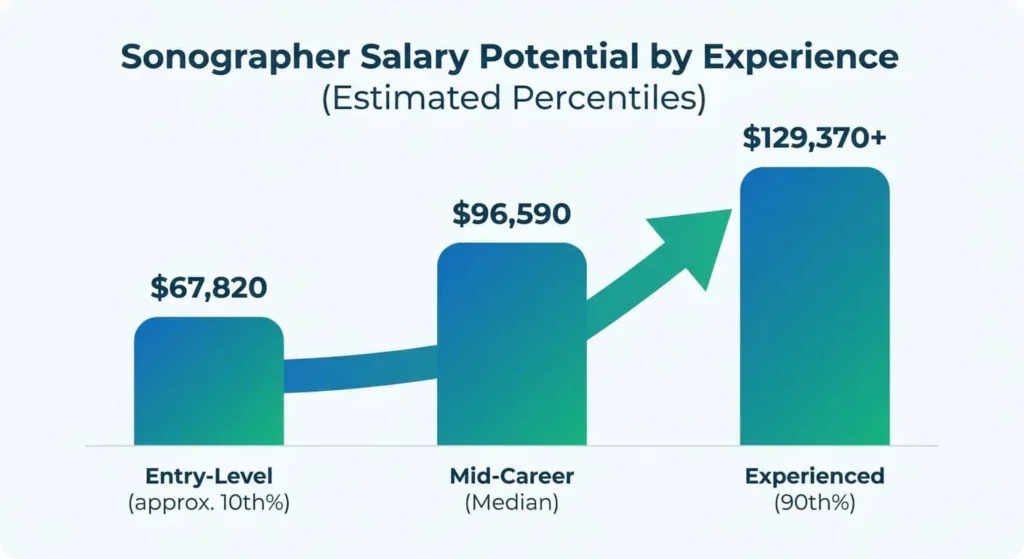
BLS doesn’t publish wage data broken out by years of experience, but the percentile spread in its wage survey gives a reasonable proxy: sonographers newer to the field tend to cluster near the lower percentiles, while those with more years, more credentials, or supervisory responsibility cluster toward the top.
- Entry-level (roughly 10th percentile): around $67,820 or less
- Mid-career (median): around $96,590
- Experienced/specialized (90th percentile): $129,370 or more
Movement up this range usually comes from a combination of added certifications, taking on a harder-to-staff specialty (like cardiac or vascular), and simply accumulating years in the role, not from any one factor alone.
Do Certifications Affect Sonographer Pay?
Yes, certification is less about hitting a specific pay bump and more about which jobs you’re even eligible for, since many employers require it outright. Three main organizations certify sonographers:
- ARDMS (American Registry for Diagnostic Medical Sonography): the most widely held credential body. Candidates must pass the SPI (Sonography Principles & Instrumentation) physics exam plus one or more specialty exams (abdomen, OB/GYN, breast, pediatric, etc.) to earn the RDMS (Registered Diagnostic Medical Sonographer) or RVT (Registered Vascular Technologist) credential.
- ARRT (American Registry of Radiologic Technologists): better known for radiology credentials, but also offers a sonography credential (ARRT(S)); some states require ARRT specifically for licensure.
- CCI (Cardiovascular Credentialing International): the preferred certifying body for cardiac and vascular specialists, offering credentials like RCS (Registered Cardiac Sonographer) and RVS (Registered Vascular Specialist).
Certifications require ongoing continuing medical education to maintain, and holding credentials across more than one specialty is one of the more reliable ways to qualify for higher-paying roles and shift differentials.
Job Outlook for Ultrasound Technicians
Employment of diagnostic medical sonographers is projected to grow 14% from 2025 to 2035, far faster than the 3% average projected across all occupations, with roughly 6,000 openings expected each year over the decade. Most of that growth is tied to an aging population that needs more imaging to diagnose age-related conditions, along with sonography’s expanding role as a lower-cost, radiation-free alternative to other diagnostic imaging.
How to Become an Ultrasound Technician
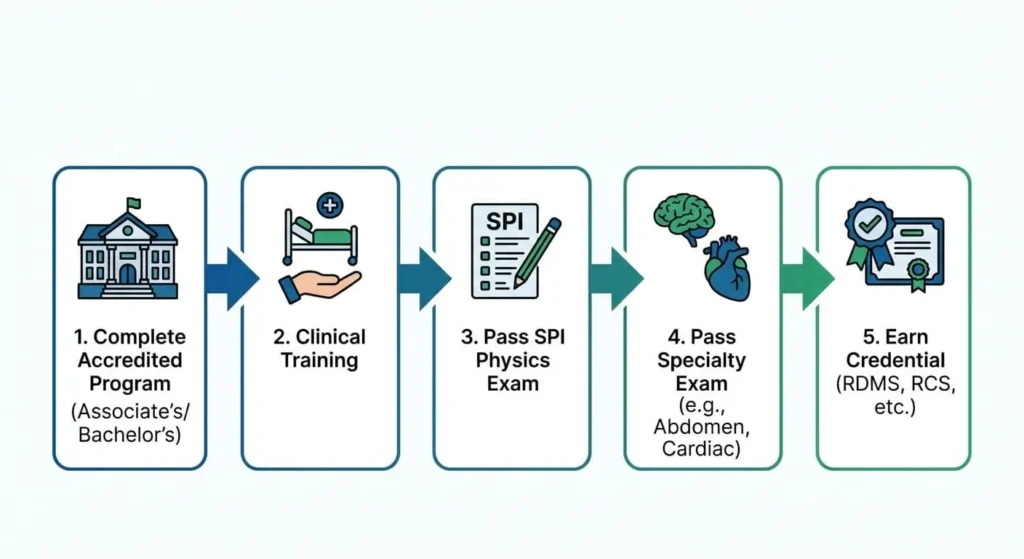
- Complete a sonography program. Most sonographers hold an associate’s degree; some hold a bachelor’s or a postsecondary certificate (often for those who already have a healthcare background). Look for CAAHEP-accredited programs, since accreditation affects certification eligibility.
- Complete clinical training. Sonography programs include a hands-on clinical component where students scan real patients under supervision.
- Pass the SPI physics exam. Required by ARDMS before any specialty exam.
- Pass a specialty exam in your chosen area (abdomen, OB/GYN, cardiac, vascular, etc.) to earn your registered credential.
- Meet state licensure requirements, where applicable, not all states require a separate license, but some do.
- Maintain your credential through continuing education, as required by your certifying body.
How to Increase Your Earning Potential as a Sonographer
- Add a second specialty credential. Sonographers who can cover both general and vascular or cardiac exams are more valuable to schedule and typically command higher pay.
- Consider outpatient or specialty imaging centers, which post the highest median wages in BLS data, though often with less scheduling flexibility than a hospital.
- Weigh travel or per diem sonography work. Short-term contract positions can pay a premium over staff roles, though they trade off benefits and job security.
- Track state-level demand. States with fewer training programs relative to open positions tend to offer higher starting pay to attract talent.
- Move into a lead or supervisory sonography role as you gain experience, which typically pays more than staff scanning alone.
Ultrasound Tech Salary vs. Similar Healthcare Careers
| Occupation | Entry Education | 2025 Median Pay |
|---|---|---|
| Diagnostic Medical Sonographer | Associate’s degree | $96,590 |
| Registered Nurse | Bachelor’s degree | $97,550 |
| Radiologic Technologist | Associate’s degree | $81,390 |
| Respiratory Therapist | Associate’s degree | $82,280 |
| Cardiovascular Technologist/Technician | Associate’s degree | $74,310 |
| Nuclear Medicine Technologist | Associate’s degree | $101,370 |
Source: BLS Occupational Outlook Handbook, similar occupations data, May 2025.
Among careers reachable with a two-year degree, sonography is one of the higher-paying options, on par with fields that typically require a four-year degree, like nursing.
Frequently Asked Questions
What is the national average salary for an ultrasound technician?
The BLS reports a median (not average/mean) salary of $96,590 per year as of its latest release. Median is generally the more reliable figure since it isn’t skewed by a small number of very high earners.
Which state pays ultrasound techs the most?
California currently reports the highest median pay among states with published data, followed by Hawaii and Washington.
Do you need a certification to work as an ultrasound tech?
Most employers require it, even where it isn’t legally mandated. ARDMS is the most common certifying body, though ARRT and CCI credentials are standard in some specialties and states.
How long does it take to become an ultrasound technician?
Most people complete an associate’s degree program in about two years, though accelerated certificate programs exist for those who already hold a healthcare degree.
Do specialized sonographers earn more than general sonographers?
There’s no official BLS breakdown by specialty, but industry hiring patterns suggest sonographers with in-demand credentials, particularly cardiac and vascular, are often positioned for higher pay due to more limited supply of qualified candidates.
Is ultrasound tech a good career choice in 2026?
The field’s 14% projected growth through 2035, combined with pay that’s competitive with jobs requiring a four-year degree, makes it a strong option for those who want a healthcare career without a lengthy degree path.
What’s the difference between a sonographer and a radiologic technologist?
Sonographers specialize in ultrasound imaging; radiologic technologists typically work with X-ray and other radiation-based imaging. Some professionals cross-train in both.
Does travel sonography pay more than staff positions?
Short-term travel and per diem contracts can offer a premium over standard staff pay, but they generally don’t include the benefits or job security of a permanent role.
Also Read: Why Is Foresight Not Getting Traction With Business?